TumbleBook Library is a password protected website that school libraries may purchase. The link I have chosen provides an opportunity for teachers and librarians to take a tour of the program which helps demonstrate all the learning tools available. TumbleBooks offers students a chance to select audio books with animation. Once the story is complete the student may take a quiz, play vocabulary games, put puzzles together and many more activities focusing on the book. TumbleBooks provides AR books which is especially effective for kindergarten students who are not quite ready to read independently before taking an AR quiz. I chose to share this website because I have found it successful in my classroom and library. My students are excited to read books and play games on TumbleBooks. One of my topics of interest is encouraging children to read and providing an environment that fosters a love of reading. This website provides an alternate and fun form of reading for students. I found TumbleBook Library through the Lycos Internet Search Engine. I searched tumble books and the first result was the website I needed.
http://www.tumblebooks.com/library/asp/home_tumblebooks.asp
Monday, April 26, 2010

Sunday, April 25, 2010
Competency 8: Research Visual/Multimedia
 Image retrieved from: http://www.schoollibraryjournal.com/article/CA6633729.html and http://ncacblog.wordpress.com/2009/02/05/fearing-backlash-many-librarians-censors-themselves/
Last semester while taking Information Professions, I was introduced to the world of library censorship. As a future school librarian I am aware of the fact that parents, administrators, and students may challenge books selected for the library. Through a Google Images search: Texas School Library Graph, I found a blog Blogging Censorship with a post that addresses the censorship topic in schools. I have posted one graph from the blog which is dedicated to censorship. The information on the blog orginated from an article from School Library Journal: SLJ School Censorship Survey by Debra Whelan. She provides background data on how the survey was conducted. She also presents additional graphs with survey results. I found her survey very informative as I am a student still gaining knowledge of how to be the most effective school librarian.
Whelan, Debra. (2009). Slj self-censorship survey. School Library Journal Online, http://www.schoollibraryjournal.com/article/CA6633729.html.
Sunday, April 18, 2010
Competency 7: Image
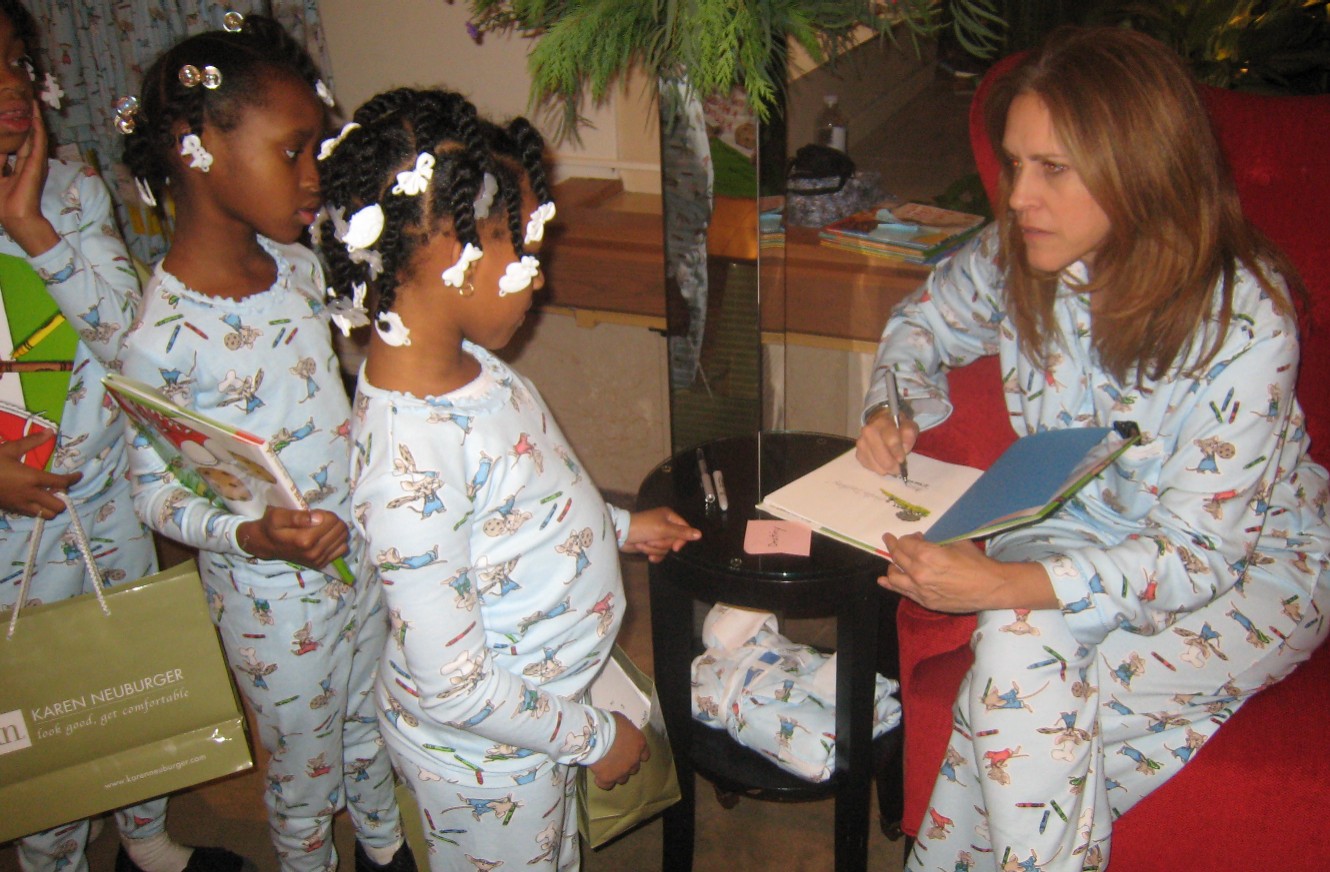
I chose to share this image because I feel it is important that children not only read books but that they also have the opportunity to meet authors. The author in this picture is Laura Numeroff. She has written circular stories such as If You Give a Mouse a Cookie and If You Give a Moose a Muffin. She is one of my favorite children's authors who I would love to meet one day. I found this picture intriguing because Ms. Numeroff is in her pajamas in an effort to encourage parents to read to their children at bedtime. Her pajamas incorporate the mouse from her story. I also like the look on her face, she is concentrating and showing an interest in what the child is telling her. It is so important for children to see and hear first hand how an author came to write stories. Who knows which children will be inspired to read or even write stories to publish. I found the picture by searching "Laura Numeroff" in Google Images. This picture is part of the First Book blog.
Citation: Bookmark: the first book blog. (2006). http://blog.firstbook.org/2007/11/30/author-laura-numeroff-celebrates-books-at-bedtime/ Retrieved April 18, 2010.
Saturday, March 27, 2010
Competency 6: Database Search 4: Library Literature using Pearl Growing
Naïve Question: How do state and/or district budget cuts affect school libraries?
Introduction: I chose to use the Library Literature database because my question pertains to libraries and this database focuses on library and information science materials. I am hoping to modify the information I obtained from my Eric/First Search specific facet search as I use the pearl growing strategy to obtain more information that supports my query.
I chose to start with an article I retrieved during my first database search within Eric/First Search. Upon retrieval I looked for terms or concepts that I could use to develop a search.
Allen, M., & Bradley, A. (2009). Portfolios: Justify Your Job as a Library Media Specialist and the Media Budget during Times of Budget Cuts. Library Media Connection. 28(3), 48-50.
When reading the article and the provided subject headings I found the terms: media center budget, media funds, expenditures, budget, budget cuts and school libraries/finance.
For my first search I am going to select: school libraries, finance, and budget cuts in a subject search.
SS1: (school librar*) AND (finance) AND (budget cut*) = 0 results (subject search)
I am going to change my search from a subject search to a keyword search.
SS2: (school librar*) AND (finance) AND (budget cut*) = 29 records (keyword search)
This search was successful and I found several articles that relate to my topic.
Whelan, D. (2004). Library Cuts Still Run Deep. School Library Journal, 50(7), 15-16. Retrieved March 27, 2010, from Library Lit & Inf Full Text database.
Ishizuka, K. (2003). Back-to-School Blues Felt Nationwide. School Library Journal, 49(10), 20-1. Retrieved March 27, 2010, from Library Lit & Inf Full Text database.
Whelan, D. (2003). Texas Education Agency Axes Jobs. School Library Journal, 49(9), 18. Retrieved March 27, 2010, from Library Lit & Inf Full Text database.
All of the previously mentioned articles have school libraries/finance as subject(s). I decided to do a search using the heading just as it is written to see if any other articles pertaining to my topic are retrieved.
SS3: (school library*/finance) AND (budget cut*) = 0 results (subject search)
Since there were no results using a subject search I am going to try a keyword search.
SS4: (school library*/finance) AND (budget cut*) = 6 results (keyword search)
Through this final search I found an article that has answers to my question including how budget cuts affect the students. I am glad that I continued searching as I have found a third article with much needed information.
Adams, H. (2007). How School Budgets Affect Students' Intellectual Freedom. School Library Media Activities Monthly, 24(3), 30. Retrieved March 27, 2010, from Library Lit & Inf Full Text database.
Reflection: I was a little hesitant in the beginning to use the pearl growing strategy. I wasn't sure I could find enough subject headings or keywords to use. I discovered that by using this technique I am more aware of the information that is provided when viewing a record. I am paying closer attention to not only the abstract provided but also the subjects or keywords offered. I was able to take the subject "school libraries/finance", which was listed on several retrieved articles and once I placed it in a search it provided 6 more articles related to my query. I am thrilled to finally feel successful when completing database searches using new searching techniques such as pearl growing. Now that I understand how to use this search strategy I will be more willing to try it.
Competency 6: Database Search 3: Eric/First Search using Specific Facet
Naïve Question: How do state and/or district budget cuts affect school libraries?
Introduction: I chose this topic because I am interested in finding out what information is available supporting librarians and/or providing librarians with information pertaining to district and state budget costs. I chose to use the Eric/First Search because I wanted some more practice using it and it focuses on reference material that pertains to education topics. I felt somewhat successful the first time I used it. I selected the specific facet search strategy because I have several facets in my query to pick from when choosing the most specific one. I was a little nervous to even attempt this strategy because Chu (2003) mentions this approach is "virtually impossible for a novice user to single out the most specific facet in a multiconcept search request" (p. 86).
From my question I selected budget cuts as my most specific facet. I have a feeling I will receive a large number of results and that many of them will not pertain specifically to school libraries.
Search Terms Records retrieved (all subject searches)
Facet 1: budget cut* 2 (neither article pertains to my query)
Facet 2: school librar* 7,388
Facet 3: district 12,893
Facet 4: state 77,916
After using the 1st facet, budget cut*, I chose to continue with searching other facets to verify the number of records retrieved. By reviewing my results I think I will begin with budget cut* and add school librar*.
2nd Search Statement: (budget cut*) AND (school librar*) = 0 results (subject search)
I feel this happened because neither of the two articles retrieved on my facet search pertain to my query. I am going to search budget cut using keyword and leaving school library as a subject search.
3rd Search Statement: (budget cut*) AND (school librar*) = 29 results (kw: budget cut & su: school library)
These results are much better but I am going to continue searching by adding an additional facet to see if I can get more precise results. I will do a subject search with district.
4th Search Statement: (budget cut*) AND (school librar*) AND (district*) = 0 results (kw: budget cut, su: school library, su: district)
Again the subject search is not producing results so I am going to have district and budget cut be a keyword search and school library a subject search.
5th Search Statement: (budget cut*) AND (school librar*) AND (district*)= 5 results (kw: budget cut, su: school library, kw: district)
I found one article that interests me because it focuses on librarians and what to do if there is a budget issue in a specific district, but the rest of the results really don't answer or apply to my query. So, maybe it is time to revisit and rebuild my statement.
Johnson, D. (2005). When Your Job Is on the Line: Strategies for Assisting Library Media Specialists Whose Positions Are in Jeopardy. Library Media Connection. 23(5), 44.
For my next search I chose to eliminate district and replace it with state.
6th Search Statement:
(budget cut*) AND (school librar*) AND (state*) =1 unrelated result (kw: budget cut, su: school library, su: state)
Again using a subject search for state gave 0 results so I will use a keyword search for state.
7th Search Statement:
(budget cut*) AND (school librar*) AND (state*) = 10 results (kw: budget cut, su: school library, kw: state)
I was happy with the number of results and found a couple of articles that provide some insight into the opposing views about the importance of school libraries and what librarians can do to improve the support for school libraries as well as increase the available funds.
Pope, K., Chenoweth, R., Bersche, K., & Bell, L. (2006). Starting and Running the "Libraries Matter" Campaign. Computers in Libraries. 26(8), 6-8, 55-56.
I am still interested in finding something that pertains to how budget cuts are really affecting school librarians so I attempted one more search still using my original facet budget cut. The difference is that I used a title search for the 1st facet and kept a subject search for the 2nd facet.
8th Search Statement: (budget cut*) AND (school librar*) = 2 results (tt: budget cut, su: school library)
I found an article that I liked from my search results.
Watt, B., & Schon, I. (1982). The Effects of Budget Cuts on Elementary School Library Media Centers. School Library Media Quarterly. 11(1), 58-62.
REFLECTION: It took me longer than I thought to use the specific facet strategy. I like the idea of choosing the most specific facet and searching for the number of results. This is especially effective when using unfamiliar databases that may or may not have pertinent information. A large amount of search time is saved if the most specific facet comes up with very few results. I still have some trouble pinpointing the exact wording needed to successfully find needed material. I continue to find myself frustrated when searching because it seems to take me forever to locate what I am looking for in the various databases, but I will continue to practice. I also tried to focus my searches using only subject searches, but through trial and error I realized that it is not possible to always use subject searches alone.
Works Cited:
Chu, H. (2003). Information representation and retrieval in the digital age. Medford, NJ: Information Today, Inc.
Competency 6: Database Search 2: Academic Search Complete using Building Block
Naïve Question: How does an education obtained from a public school education compare to a private school education?
Introduction: I chose to use this database for a building block search because it has a thesaurus and I can use a Boolean Statement. The database contains journals with full text and I wanted to complete a search to see if there were articles that pertain to my question. In my previous database search I found several books so I know there is material available.
First I will identify the facets of the question. I am going to have four facets by splitting up private and public school.
Facet 1: public school*
Facet 2: private school*
Facet 3: education
Facet 4: compar*
Next I will identify synonyms for each facet using the thesaurus.
Private school*: private schools, school choice
Public school*: public schools
Education: education-aims and objectives
Compar*: differences, comparison, comparative education
Now I will combine some of the facets and build my first Boolean search statement in hopes that I have a little success on my first try. I am going to use my original facets first and then move on to the synonyms as needed.
Private school* AND Public school* AND Education AND Compar*
The string will read: (private school*) AND (public school*) AND (education) AND (compar*)
SS1: (private school*) AND (public school*) AND (education) AND (compar*) = 6 results (SU subject terms search)
Wow!!! In a previous search with the same Boolean Statement I used the keyword search and received 0 results. Upon Dr. Perryman's suggestion I tried using a subject term search and BAM I have 6 results and of the six 2 are right on target.
O'Brien, R., & Pianta, R. (2010). Public and Private Schools: Do Classroom Processes Vary by School Type?. Elementary School Journal, 110(3), 409-419. Retrieved from Academic Search Complete database.
Dronkers, J., & Robert, P. (2008). Differences in Scholastic Achievement of Public, Private Government- Dependent, and Private Independent Schools: A Cross-National Analysis. Educational Policy, 22(4), 541-577. Retrieved from Academic Search Complete database.
Okay, because that seemed way too easy I am going to try another search using differ* instead of compar* in an SU search.
SS2: (private school*) AND (public school*) AND (education) AND (differ*) = 1 result (SU: subject terms search)
The one article did not pertain to my query. I am going to try one last search not using differ* or compar*. I am curious to see if I receive any different articles from my first search.
SS3: (private school*) AND (public school*) AND (education) = 293 results (SU: Subject terms search)
Of the results one of my previous selected articles is mentioned. Most of the first 20 I looked through did not address my query which supports my choice to use compare and differ to weed out unwanted or unneeded material.
Reflection: Oh my goodness! This was the most productive and quickest database search I have completed so far in my course. I have a feeling of success, which doesn't happen very often as I usually become frustrated with database searching and trying to configure just the right search statement and facets. I hope my level of success is also contributed to the fact that I have been practicing different search techniques including the building block. I enjoy using the Academic Search Complete database as it is very user friendly and has numerous journals that pertain to my topic of school librarian. After revising this search I understand the importance of attempting a subject terms search before using anything else such as a keyword or title search.
References:
Perryman, C. Four basic search strategies [PowerPoint slides]. Retrieved from Module 6 notes Basic Search Techniques: http://online.twu.edu/webapps/portal/frameset.jsp?tab_id=_2_1&url=%2Fwebapps%2Fblackboard%2Fexecute%2Flauncher%3Ftype%3DCourse%26id%3D_204485_1%26url%3D
Competency 6: Database Search 1: Books in Print using Successive Fractions
Naïve Question: How does the education obtained from a public school education compare to a private school education?
Introduction: I choose to use Books in Print for my first database search because I had a difficult time using it with my previous search. I want to feel successful using a variety of databases. I am definitely a novice and know that with practice I will gain confidence and a better understanding of how to use Books in Print to my advantage. I also thought my query might result in a book instead of just articles and this database produces book, audio, and video results. I have used the successive fractions search strategy.
Organization Table:
Facets | School | Public and Private | Education | compare |
My initial terms | Schools secondary primary | state funded | learning curriculum | pros & cons likes & differences compare & contrast |
Subject (all) search for individual facets:
Education = 322,923 results
School* = 50,253 results
Public AND private = 415 results
Compar* = 0 results
1st Search- using the facet "education"
Since successive fractions searching focuses on beginning with the facet that retrieves the largest amount of results. I started with "education". I used the word in different forms to see how the results compared.
Education = 322,923 results
Education* = 327,569 results
All used Subject (all) search
I choose to continue with the 1st facet "education" and add a 2nd facet "school*.
SS1: education AND school* = 45,356 results using subject (all) search
I was really feeling successful as the number of results began to decrease. After perusing the books there were some that pertained to my query, but I decided to add a 3rd facet "private AND public".
SS2: education AND school* AND (private AND public) = 58 results using subject (all) search
The results are still too broad as many of them do not focus on my query. So, this time I am going to add the word compare and use truncation "compar*".
SS3: education AND school* AND (private AND public) AND compar* = The subject (all) search had 0 results, so I changed "compar*" to keyword in title and received 8 results
It felt terrific to narrow down my search from 322, 923 results to simply 8 and even better from the 8 results I found a book that might have information pertaining to my query.
RESULTS:
Baker, David, et al, How Different, How Similar?: Comparing Key Organizational Qualities of American Public and Private Secondary Schools
I decided to try one more search to see if I could retrieve more accurate results. I used the first two facets as done previously and changed the third one to "differ*".
SS4: education AND school* AND (private AND public) AND differ*= 1 result (keyword in title for differ the first two facets were subject (all) search)-The keyword in subject search had 0 results.
RESULTS:
I was even happier with these results. The books seem a little more relevant to my query. My question is broad which at times may hinder my results but this time it proved to be helpful because the books I found compare public and private education as a whole and then dedicate chapters to each specific area or subject.
Hall, GK, Benveniste, Luis, Carnoy, Martin, & Rothstein, Richard. (2002). All else Equal: are public and private schools different?. United States: Routledge.
Baker, D, Han, M, Keil, C, & Broughman, S. (1998). How Different, how similar?: comparing key organizational qualities of american public and private secondary schools. United States: DIANE Publishing Company.
Out of curiosity I am going to complete another search and change the word choice between the facets. I would like to see if I receive any additional and useful books.
SS5: (school* OR education) AND (private AND public) = 72 results (subject (all) search)
After reviewing the results I did not receive anything new or different from previous results. I think I could try different facet combinations for awhile because as silly as it seems it is like a game and the more successful results I find the better I feel. It is fun! I am not going to continue because I have exhausted my facets and the results continue to be the same.
Reflection:
After completing the successive fraction search within Books in Print, I have a better understanding of the database and the tools provided to help users. I like the search strategy and think with further practice I won't have to constantly refer to my notes or the textbook to confirm if I have completed the search correctly. I like using successive fractions in a database because I get the opportunity to test the database to see if my facets are hits and if so are there enough to continue searching for answers to my query. I was successful in finding relevant materials pertaining to my question. I am confident the information I need will be provided by the books I have selected.
References:
Perryman, C. Four basic search strategies [PowerPoint slides]. Retrieved from Module 6 notes Basic Search Techniques: http://online.twu.edu/webapps/portal/frameset.jsp?tab_id=_2_1&url=%2Fwebapps%2Fblackboard%2Fexecute%2Flauncher%3Ftype%3DCourse%26id%3D_204485_1%26url%3D
Monday, February 22, 2010
Competency 5: Tagging and Indexing
As a future elementary librarian one of my interests is providing quality literature for all children. More specifically, I want to stock the library with books that meet the interest of every child. If a book is not in the library I will use my searching skills to purchase one. Through my experience as a teacher as boys get older some lose their interest in reading whether it be because it becomes difficult, too time consuming, or maybe they would rather play video games. It will be my job as a librarian to spark an interest in every child, including boys. I found a book on LibraryThing that might be an excellent consulting tool when I am needing a book idea for a particular boy and his interests. Best Books for Boys: A Resource for Educators (Children's and Young Adult's Literature Reference) by Matthew D. Zabaracki, is a book organized by genre. The tag doesn't provide much information about the book in fact I added the tag literature for boys. So, after searching futher I also found some related tags using Library Thing.
Original Tags
literature for boys (1) read in 2010 (1) reader's advisory (1) reference (1)
Related Tags
20th century (1,302) adventure (3,795) american (959) american literature (872) british (1,311) children (929) children's (1,634) classic (6,410) classics (3,674) comics (2,064) coming of age (1,048) dystopia (5,772) fantasy (19,170) fiction (39,233) future (772) graphic novel (1,928) hobbits (801) literature (3,378) lord of the rings (1,366) magic (748) middle earth (1,528) mystery (2,635) novel (4,746) own (1,825) paperback (939) read (6,453) religion (1,353) sci-fi (3,778) science fiction (9,922) series (1,392) sf (1,809) suspense (703) thriller (1,805) tolkien (2,370) unread (1,290) vampires (797) war (729) YA (2,760) young adult (3,629)
This information was found using Library Thing.
Original Tags
literature for boys (1) read in 2010 (1) reader's advisory (1) reference (1)
Related Tags
20th century (1,302) adventure (3,795) american (959) american literature (872) british (1,311) children (929) children's (1,634) classic (6,410) classics (3,674) comics (2,064) coming of age (1,048) dystopia (5,772) fantasy (19,170) fiction (39,233) future (772) graphic novel (1,928) hobbits (801) literature (3,378) lord of the rings (1,366) magic (748) middle earth (1,528) mystery (2,635) novel (4,746) own (1,825) paperback (939) read (6,453) religion (1,353) sci-fi (3,778) science fiction (9,922) series (1,392) sf (1,809) suspense (703) thriller (1,805) tolkien (2,370) unread (1,290) vampires (797) war (729) YA (2,760) young adult (3,629)
This information was found using Library Thing.
Library Literature Search
I chose to continue my search using the same question I posed when completing my World Cat and ERIC searches. I wanted to see what other related information and articles were available for my topic because I am very interested in maintaining open communication with my classroom teachers. I want to plan library lessons that complement the curriculum being taught within the classroom. As a current teacher I am constantly team planning and sharing with my teaching partner and other grade levels through vertical teaming. One of my goals and hopefully strengths as a school librarian will be to use the library as an enrichment tool as well as a research tool for students to use as they extend what has been taught in the classroom.
Naïve Question: As a school librarian how can I improve teacher/librarian collaboration involving curriculum to academically benefit elementary students?
Key Terms/Facets | Teacher/librarian collaboration | Curriculum | Elementary students | |
My initial terms | Teamwork vertical teaming teacher/media specialist | academics lesson plans | PreK-6th grade primary students grade school | |
Thesaurus Terms (Subject Headings) | School libraries/Relations with teachers and curriculum Teacher education and the school library Education | School libraries/activity projects Teacher education and the school library | School libraries/Activity projects Children's literature/Evaluation Children's library services | |
Keyword Searching Notes:
This keyword search did not take as long as the Books in Print. For my first facet I completed five searches. The first one I used teacher/librarian collaboration which found the heading school libraries/relations with teachers and curriculum. The second search using school libraries/relations with teachers and curriculum resulted in a match of teacher education and the school library. My third search using teacher/librarian cooperative came back with zero matches. My fourth search using teacher/librarian teamwork also had zero results. My final search I used collaboration and found education as a subject heading. My second facet search began with lesson plans which resulting with school libraries/activity project. My second search using activities as an initial term gave me several words but none of them were of interest to me. My final search I used curriculum and found the heading teacher education and the school library. My final subject heading search took the most time out of all three. I started with elementary students which had zero results and did students as an initial term. My third search using primary students was successful resulting in school libraries/activity projects. My fourth search using Grade K-6 resulted in children's literature/Evaluation. My final heading search using children resulted in children's library services.
Library Literature provided a search with a larger number of appropriate results. Even though some did not pertain to my naïve question they did offer some new ideas for keywords and subject headings.
Boolean Search:
Teacher/librarian collaboration AND | Curriculum AND | Elementary students |
School libraries/Relations with teachers and curriculum OR Teacher education and the school library OR Education | School libraries/Activity Projects OR Teacher education and the school library | School libraries/Activity projects OR Children's literature/Evaluation OR Children's library services |
Boolean Search Statement:
(School libraries/Relation with teachers and curriculum OR Teacher education and the school library OR Education) AND (School libraries/Activity projects OR Teacher education and the school library) AND (School libraries/Activity projects OR Children's literature/Evaluation OR Children's library services) (all in subject field)
SS1: (School libraries/Relation with teachers and curriculum OR Teacher education and the school library OR Education) AND (School libraries/Activity projects OR Teacher education and the school library) AND (School libraries/Activity projects OR Children's literature/Evaluation OR Children's library services) (all in subject field)
Results: 88 records
Notes: To me it really seems like too much information is provided in my first search statement. There are a number of hyphens and backslashes that might interfere with acquiring quality results. I think I need to consolidate my subject headings and make them a little more precise.
SS2: (School libraries/Relations with teachers and curriculum OR teacher education and the school library) AND (school libraries/activity projects) AND (children's library service) (all in subject field)
Results: 2 records
Notes: Whoa, I am not sure what happened but obviously I need to rethink my search. The two results have nothing to do with my topic.
SS3: (School libraries) AND (Relations with teachers and curriculum)
Results: 1,609 records
Notes: Obviously I have now made my search too vague-time to rethink once again.
SS4: (School librarians) AND (Relations with teachers) AND (curriculum)
Results: 80 records
Notes: I know this still seems like a large number of results but I did find an article that interests me and really addresses my question. The article advocates librarians and teachers working together to provide quality activities in the library.
Buzzeo, T. (2007). Literacy and the Changing Role of the Elementary Library Media Specialist. Library Media Connection, 25(7), 18-19. Retrieved February 22, 2010, form Library Lit & Inf Full Text database.
This database search did not take as much time as the Books in Print search, although it was harder than using World Cat and ERIC databases. I know that with each database search I am becoming more familiar and hopefully and little less hesitant about using databases as research resources.
Books in Print
I chose to continue my search using the same question I posed when completing my World Cat and ERIC searches. I wanted to see what other related information and articles were available for my topic because I am very interested in maintaining open communication with my classroom teachers. I want to plan library lessons that complement the curriculum being taught within the classroom. As a current teacher I am constantly team planning and sharing with my teaching partner and other grade levels through vertical teaming. One of my goals and hopefully strengths as a school librarian will be to use the library as an enrichment tool as well as a research tool for students to use as they extend what has been taught in the classroom.
Naïve Question: As a school librarian how can I improve teacher/librarian collaboration involving curriculum to academically benefit elementary students?
Key Terms/Facets | Teacher/librarian collaboration | Curriculum | Elementary students |
My initial terms | Teamwork vertical teaming teacher/media specialist | academics lesson plans | PreK-6th grade primary students grade school |
Thesaurus Terms (Subject Headings) | Libraries and students Libraries, children | Curriculum planning Curriculum planning and development | Primary/junior schools Children-books and reading |
Keyword Searching Notes:
This keyword search took the longest out of all four database searches I have completed so far. My first subject heading search was teacher/librarian collaboration and my first results focused only on teachers and did not include librarians. So, I continued my search with librarian/teacher collaboration which resulted with libraries and students and librarians, children. I decided to complete a third search using media specialists which retrieved zero results. My second subject heading search for curriculum was successful in one search with the results including curriculum planning and curriculum planning and development. My final subject heading search for my third facet began with elementary students which gave me zero results. The second search using students came up with zero results also. I tried elementary as a keyword but the results did not address the question I am trying to answer. My fourth search using primary students gave me primary/junior schools. My final search using children gave me the results of children-books and reading and children's libraries.
I found my keyword search in Books in Print to be rather frustrating. There were not as many exact matches for words that related to my question. This searching process took a very long time and I found it was not a very productive search. I am hoping as I move on to my Boolean Search that I have better results.
Boolean Search:
Teacher/librarian collaboration AND | Curriculum AND | Elementary students |
Libraries and students OR Libraries, children | Curriculum planning OR Curriculum planning and development | Primary/junior schools OR Children-books and reading OR Children's libraries |
Boolean Statement:
(Libraries and students OR Libraries, children) AND (Curriculum planning OR Curriculum planning and development) AND (Primary/junior schools OR children-books and reading OR Children's libraries)
SS1: (Libraries and students OR Libraries, children) AND (Curriculum planning OR Curriculum planning and development) AND (Primary/junior schools OR children-books and reading OR Children's libraries) (all in subject field)
Results: no matches
Notes: Apparently I have too much information in my search and I need to narrow it down.
SS2: (Teacher/librarian collaboration) AND (Curriculum Planning OR Curriculum Development) AND (Primary/Junior schools) (all in subject field)
Results: No matches
Notes: My search is still too broad.
SS3: (Libraries) AND (Curriculum Planning) AND (elementary students) (all in subject field)
Results: No matches
Notes: I am not sure if I am still including too many subject headings. I am thinking about eliminating one facet.
SS4: (Librarian OR teacher) AND (Curriculum) (all in subject field)
Results: 575 records
Notes: Now, I am finally getting somewhere, but there are too many records and they are not really focused on my question. So, I need to be a little more specific to help eliminate some of the results.
SS5: (Librarian OR teacher) AND (Curriculum) AND (elementary) (all in subject field)
Results: 88 records
Notes: Yea, now I have eliminated almost 500 results, but I still wish I could have fewer records. After carefully examining most of the results I have noticed that most focus on teacher's curriculum in the classroom, not the library.
SS6: (Librarian OR teacher) AND (curriculum planning) AND (elementary) (all in subject field)
Results: 33 records
Notes: I am still struggling with records that do not mention library.
SS7: (library) AND (activities) AND (elementary) (all in subject field)
Results: 7 records
Notes: Whoo Hoo! I found some very useful books to jump start ideas when collaborating with teachers. These ideas will assist me when I am meeting with specific grade levels and attempting to align the grade level curriculum with library activities. The following book I found to be quite useful:
Keeling, J. (2005). Lesson plans for the busy librarian: a standards based approach for the elementary library media center, volume 2. United States: Greenwood Publishing Group, Incorporated.
This database search was my most difficult and time consuming so far. I am wondering if my naïve question was not stated clear enough or maybe wasn't appropriate for this type of database.
Sunday, February 14, 2010
Competency: World Cat and ERIC
Naïve Question: As a school librarian how can I improve teacher/librarian collaboration involving curriculum to academically benefit elementary students?
I chose this question because I want collaboration with teachers to be one of my strengths as a school librarian. I have worked in several different schools and within each school I have encountered a variety of librarians who each demonstrate different strengths and weaknesses. As a teacher I feel that my students would benefit more from library use if they understand how to connect what they have learned in the classroom and utilize the library and its contents. I know that with younger students this may be a little more difficult, but by collaborating with the classroom teachers I feel that as a librarian I could find a connection for every grade level. I want students to understand all the uses and services the library provides.
ERIC search
Key Terms/Facets | Teacher/librarian collaboration | Curriculum | Elementary students |
My initial terms | Teamwork vertical teaming teacher/media specialist | academics lesson plans | PreK-6th grade primary students grade school |
Thesaurus Terms (Subject Headings) | Cooperation Cooperative planning Librarian Teacher Cooperation | Curriculum design Curriculum development Curriculum enrichment | Elementary school students |
My first subject search of teacher/librarian collaboration and teacher and librarian collaboration resulted in zero matches. My second subject search of just collaboration resulted in the subject cooperation. My third search with teacher collaboration resulted in cooperative planning. My fourth search with librarian collaboration resulted in zero results. Finally on the fifth search I used librarian cooperation and received the result of Librarian Teacher Cooperation. My first search for curriculum gave me several subject headings which included curriculum design, curriculum development, and curriculum enrichment. My first search for elementary students resulted with elementary school students. I tried to search primary students, PreK-6th students, grade PreK-6th and did not find any results.
Boolean Search:
Teacher/librarian collaboration AND | Curriculum AND | Elementary students |
Cooperation OR Cooperative planning OR Librarian Teacher Cooperation | Curriculum design OR Curriculum development OR Curriculum enrichment | Elementary school students |
Boolean Search Statement:
(Cooperation OR Cooperative planning OR Librarian Teacher Cooperation) AND (Curriculum design OR Curriculum Development OR Curriculum Enrichment) AND (Elementary School Students)
SS1: (Cooperation OR Cooperative planning OR Librarian Teacher Cooperation) AND (Curriculum design OR Curriculum Development OR Curriculum Enrichment) AND (Elementary School Students)(all in subject field)
Results: 66 records
Notes: The list of records was too broad and I didn't find the results that I was looking forward to retrieving.
SS2: (Librarian Teacher Cooperation) AND (Curriculum design OR curriculum development OR Curriculum Enrichment) AND (Elementary School Students)(all in subject field)
Results: 3 records
Notes: I was very pleased with the results of my second subject search. I found exactly what I was looking for in three results. The articles I selected are not as recent as I would like but both focus on integrating the classroom curriculum within the library.
Paglin, C. (2003). Keeping Your Ear to the Ground: Top School Librarians Are Constantly Alert for Ways To Team Up with Teachers. Northwest Education. 9(1), 14-18.
Gold, S. (2005). A Tale of Two Libraries: How Two Library Media Centers Seamlessly Integrate Curriculum, Information Literacy, and Technology. Technology & Learning. 26(3), 28.
World Cat search
Key Terms/Facets | Teacher/librarian collaboration | Curriculum | Elementary students |
My initial terms | Teamwork vertical teaming teacher/media specialist | academics lesson plans | PreK-6th grade primary students |
Thesaurus Terms (Subject Headings) | Teacher participation in curriculum planning | Curriculum planning Curriculum enrichment | School children |
My first search for teacher/librarian collaboration came up with zero results. I tried teacher collaboration, library collaboration, teacher librarian collaboration, teacher cooperation, and librarian cooperation and all had zero results. Typing in just teacher I found a variety of results including teacher participation in curriculum planning. Librarian brought up only one result librarian exchange program. Curriculum brought up a number of results including curriculum planning and curriculum enrichment. My final search for elementary students resulted in school children.
Boolean Search:
Teacher/librarian collaboration AND | Curriculum AND | Elementary students |
Teacher participation in curriculum planning | Curriculum planning OR Curriculum enrichment | School children |
Boolean Search Statement:
(Teacher participation in curriculum planning) AND (Curriculum planning OR Curriculum enrichment) AND (school children)
SS1: (Teacher participation in curriculum planning) AND (Curriculum planning OR Curriculum enrichment) AND (school children) (all in subject field)
Results: 2
Notes: Since librarian was not mentioned in any part of my search neither result was what I was looking for and I decided to change the keywords I used.
SS2: (Librarian OR Teacher participation in curriculum planning) AND (Curriculum planning OR Curriculum enrichment) AND (school children) (all in subject field)
Results: 21 records
Notes: I was much happier with the results of my second search in WorldCat. Of the 21 records there were several books that addressed my question.
Copeland, B. S., & Messner, P. A. (2004). Collaborative library lessons for the primary grades: Linking research skills to curriculum standards. Englewood, Colo. [u.a.]: Libraries Unlimited.
Saturday, February 13, 2010
Competency 4: RSS
I am very interested in developing comprehension reading activities that encourage higher order thinking. After searching "young readers connection to books" in a Google search I found Texas Librarian: Connecting Books, Reading Strategies, & Lesson Plans for PreK-5 Librarians. The site is authored by an elementary school librarian in Garland, Texas. She selects particular children's books and gives the schema (background knowledge) and some activities that compliment the book including areas such as: text to text connection, predicting, personification, setting, sequencing, and much more. The ideas given provide opportunities for students to use higher order thinking skills while enjoying a book. The ideas assist a librarian in demonstrating to students how good readers think. Students are given an opportunity to share their ideas with others as a librarian reads. I like that she offers ideas for a large range of grade levels. The link to the RSS is http://www.texaslibrarian.com/feed/.
Sunday, February 7, 2010
Compentency 3: Podcasts
Once again I have learned something new this week: Podcasts. I have enjoyed searching and listening to various podcasts and have begun to list particular ones I would like to share with students in the future. The search engine used was the Podcast Search Service using the keyword "children literature". The website that I found most interesting was Reading Rockets http://www.readingrockets.org/ which focuses on teaching children to read including those who struggle. There is an entire page dedicated to videos and podcasts which includes author interviews, libraries, classroom management, meet the experts, and children's books. One part of my topic interest is to encourage children to learn about different authors and what inspired them to write and become authors. I think, especially for the older students, this helps to create a connection to what is being read and they build an understanding of what the author was thinking while writing a particular book. The various authors interviewed included Eric Carle, Marc Brown, Chris Van Allsburg, Mem Fox, and Denise Fleming. The author whose interview I found most interesting was Tomie DePaola.
The video podcast link is http://www.readingrockets.org/books/interviews/depaola
Within his fifteen minute video podcast he described his book The Art Lesson and how it was based on a true story about his inspiration to draw and eventually write. I enjoyed listening to him as he is a very animated author and I plan to use this podcast in my classroom as we do our study of Tomie DePaola. I have discovered how podcasts are an excellent tool to use not only in a library but also within a classroom.
The video podcast link is http://www.readingrockets.org/books/interviews/depaola
Within his fifteen minute video podcast he described his book The Art Lesson and how it was based on a true story about his inspiration to draw and eventually write. I enjoyed listening to him as he is a very animated author and I plan to use this podcast in my classroom as we do our study of Tomie DePaola. I have discovered how podcasts are an excellent tool to use not only in a library but also within a classroom.
Sunday, January 31, 2010
Competency 2: Related Blog
Searching for blogs was something that I had not yet tried. I never realized the wide assortment of topics provided through blogging. I spent several days perusing the numerous blog results I encountered using keywords such as: librarian, school librarian, children's literature, and literature. In the beginning I didn't find many that related to my topic of interest, school librarian. My ADD kicked in as I became sidetracked reading blogs that I found interesting, but that didn't really complete the assignment. I used all the search engines provided and found three blogs that I would like to share and will continue to follow as I complete my degree and become a librarian.
I found the first one using the GoogleBlog search engine with "children's literature" as my subject. Children's Literature Book Club will be a helpful site as I continue to work towards becoming an elementary school librarian. Numerous lists of award winning books are provided. The blog's author, Stephanie Ford, leads a grownup book club where children's books are read and discussed. I will use this blog often when becoming a librarian because she not only focuses on picture books, but novels. I feel that my weakness as a librarian lies in the lack of prior knowledge of young adult authors. She provides discussion questions and ideas to follow up some of the books. I can read her selected books and participate in the book talks through her blog. In Ms. Ford's post titled January Favorites from our Youth she writes the following:
We're reading favorite books from our youth at January's meeting and everyone is welcome to bring along other old favorites to chat about.
The Westing Game - Ellen Raskin
The Mixed Up Files of Basil E. Frankweiler - E.L. Konigsburg
Sideways Stories from Wayside School - Louis Sachar
Summer of the Monkeys - Wilson Rawls
I discovered two more interesting blogs. The first one discusses current advances in technology, readers opinions of the advances, and how librarians are affected. I found it using Yahoo Blog Directories using the keywords "school librarians". Cathy Nelson's Professional Thoughts also provides an opportunity for readers to voice opinions on current events. Most recently Ms. Nelson posted an event that took place in her classroom.
Sign of the Times...
A true interaction that I had with a student Friday:
Me: So, how are you liking your new classes this semester?
Student: They’re alright, I guess.
Me: Just alright? Why not great?
Student: 3 of my 4 classes are in locations in the building where my phone does not get a signal. So those classes are just alright.
Me: What about the other class–and I don’t need to remind you of the cell phone policy here at school, do I?
Student: My other class is PE, and well, I don’t have pockets in the school issued PE uniform, so having a signal on my phone isn’t, um, useful. And you know everybody does it. Geesh.
Oh that we could channel these phones properly. Kids are very savvy in their in class use. You know, if classes are so interesting that our kids want to be on their phones instead of participating in class, what does that say about the presentation of content. Hmmmm.
The last blog, found using 100 Best Library Blogs for Library Students, is full of fun quotes for when we are feeling overwhelmed or just need a good laugh. A Librarian's Guide to Etiquette provides daily advice such as the following quote.
Sick, Calling in
Take time during your sick day to call your library and ask for yourself using a fake voice. This will not only remind your coworkers that you are ill and deserving of their pity, but it will also make them think that you are in high demand.
Through this competency I have perfected linking pages (which I had never done before)and have found a whole new world of information through blogs.
I found the first one using the GoogleBlog search engine with "children's literature" as my subject. Children's Literature Book Club will be a helpful site as I continue to work towards becoming an elementary school librarian. Numerous lists of award winning books are provided. The blog's author, Stephanie Ford, leads a grownup book club where children's books are read and discussed. I will use this blog often when becoming a librarian because she not only focuses on picture books, but novels. I feel that my weakness as a librarian lies in the lack of prior knowledge of young adult authors. She provides discussion questions and ideas to follow up some of the books. I can read her selected books and participate in the book talks through her blog. In Ms. Ford's post titled January Favorites from our Youth she writes the following:
We're reading favorite books from our youth at January's meeting and everyone is welcome to bring along other old favorites to chat about.
The Westing Game - Ellen Raskin
The Mixed Up Files of Basil E. Frankweiler - E.L. Konigsburg
Sideways Stories from Wayside School - Louis Sachar
Summer of the Monkeys - Wilson Rawls
I discovered two more interesting blogs. The first one discusses current advances in technology, readers opinions of the advances, and how librarians are affected. I found it using Yahoo Blog Directories using the keywords "school librarians". Cathy Nelson's Professional Thoughts also provides an opportunity for readers to voice opinions on current events. Most recently Ms. Nelson posted an event that took place in her classroom.
Sign of the Times...
A true interaction that I had with a student Friday:
Me: So, how are you liking your new classes this semester?
Student: They’re alright, I guess.
Me: Just alright? Why not great?
Student: 3 of my 4 classes are in locations in the building where my phone does not get a signal. So those classes are just alright.
Me: What about the other class–and I don’t need to remind you of the cell phone policy here at school, do I?
Student: My other class is PE, and well, I don’t have pockets in the school issued PE uniform, so having a signal on my phone isn’t, um, useful. And you know everybody does it. Geesh.
Oh that we could channel these phones properly. Kids are very savvy in their in class use. You know, if classes are so interesting that our kids want to be on their phones instead of participating in class, what does that say about the presentation of content. Hmmmm.
The last blog, found using 100 Best Library Blogs for Library Students, is full of fun quotes for when we are feeling overwhelmed or just need a good laugh. A Librarian's Guide to Etiquette provides daily advice such as the following quote.
Sick, Calling in
Take time during your sick day to call your library and ask for yourself using a fake voice. This will not only remind your coworkers that you are ill and deserving of their pity, but it will also make them think that you are in high demand.
Through this competency I have perfected linking pages (which I had never done before)and have found a whole new world of information through blogs.
Wednesday, January 20, 2010
Competency 1: Why Blog?
First off I have never created a blog and I am looking forward to learning something new. I have friends with blogs, but have never felt the need or desire to begin one. This blog's focus will include information and competencies for my current grad course 5013 Information Storage and Retrieval. I love teaching children and decided a year ago that after 12 years of teaching I was ready for a new challenge and adventure. My goal at the end of this new journey is to become an elementary school librarian. I love to read children's books and to share my joy with students. My topic of interest includes encouraging all children to read by introducing various authors and genres to reach every child's interests. I want to be knowledgeable in the various levels of books and what is most appropriate for each grade level. This class contributes to the knowledge needed to be the most effective school librarian possible.
Subscribe to:
Comments (Atom)